
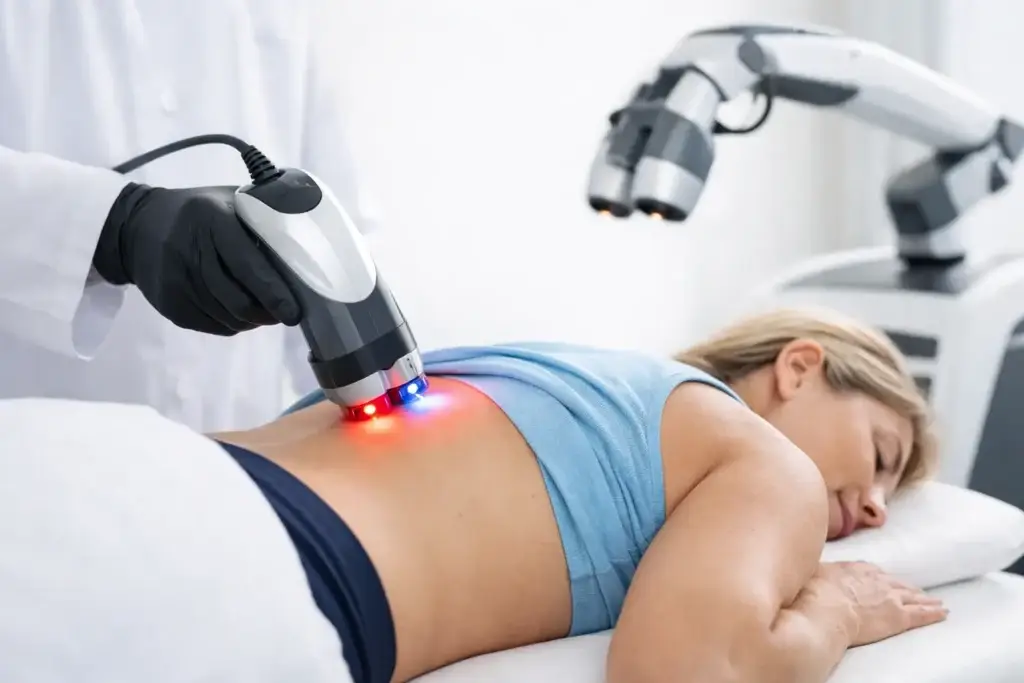
When pain keeps showing up in the same place, most people do not need another vague promise. They want to know what the treatment does, whether it is safe, and whether it makes sense for their condition. MLS laser therapy for pain is one of the non-invasive options used for that exact reason – to reduce inflammation, calm irritated tissue, and support healing in areas that are not recovering well on their own.
For many patients, the appeal is simple. There is no incision, no injection, and no downtime. But that does not mean it is a one-size-fits-all fix. The real value of MLS laser treatment is in how it is applied, what problem is being treated, and whether the underlying cause of pain has been identified correctly.
What is MLS laser therapy for pain?
MLS stands for Multiwave Locked System. It is a Class IV laser therapy designed to deliver specific wavelengths of light energy into injured or inflamed tissue. Unlike basic heat-based therapies that only create a temporary soothing effect at the surface, MLS laser therapy is used to influence cellular activity deeper in the tissue.
That matters because many painful conditions are not just about tight muscles. They involve inflammation, poor local circulation, nerve irritation, and delayed tissue repair. By targeting these processes, MLS laser therapy for pain is intended to help reduce swelling, decrease pain signaling, and support the body’s healing response.
Patients often ask whether this is the same as a heating pad or a standard cold laser. Not exactly. MLS Class IV laser therapy is more powerful than low-level laser devices and is designed to reach deeper structures. At the same time, it is controlled to avoid damaging tissue. The goal is not to numb the problem. The goal is to create conditions that allow injured tissue to recover more effectively.
How MLS laser therapy works in the body
Light therapy can sound abstract until you connect it to what pain actually feels like. Inflamed tissue tends to become chemically irritated. Nerves in the area become more sensitive. Muscles may start guarding. Movement becomes limited, which can further slow recovery.
MLS laser therapy is used to interrupt that cycle. The delivered light energy is absorbed by cells, where it can support metabolic activity and tissue repair. Clinically, the treatment is often used to reduce inflammatory markers, improve microcirculation, and decrease pain sensitivity in the treated region.
In practical terms, that may mean a patient with plantar fasciitis has less morning pain after a course of treatment. A patient with neck pain may notice less guarding and better range of motion. Someone dealing with a flare of sciatica may feel a reduction in nerve-related irritation when laser therapy is part of a broader treatment plan.
Results vary because pain varies. Acute inflammation after an injury behaves differently than chronic degenerative pain. Nerve pain behaves differently than tendon pain. That is why the technology matters, but diagnosis matters even more.
Conditions that may respond well to MLS laser therapy for pain
MLS laser treatment is commonly used for musculoskeletal and nerve-related conditions where inflammation and tissue irritation are part of the picture. That can include back pain, neck pain, sciatica, disc-related pain, shoulder injuries, knee pain, plantar fasciitis, tendonitis, sprains, strains, and some peripheral nerve symptoms.
It can also be useful after auto injuries, when soft tissue trauma and inflammation continue long after the initial event. In those cases, patients may have pain that lingers despite rest, medication, or basic physical therapy. Laser therapy may help move healing forward, especially when stiffness and pain are tied to ongoing tissue irritation.
Still, not every painful condition responds the same way. If a patient has severe structural instability, progressive neurologic loss, fracture, infection, or another serious underlying issue, laser therapy is not a substitute for the appropriate medical workup. Good clinics do not use technology to guess. They use it as part of a treatment strategy built around the actual diagnosis.
What a treatment session feels like
Most patients are surprised by how straightforward the session is. The treatment area is exposed, and the laser applicator is moved over or placed on the affected region based on the protocol. Sessions are usually short. Many people feel little to nothing during treatment, while others notice a mild warming sensation.
There is no recovery time afterward. Most patients get up and return to normal activity with whatever recommendations their provider gives them. That makes MLS laser therapy especially appealing for busy adults who want treatment that does not disrupt work, family responsibilities, or regular movement.
A single treatment may provide temporary relief, especially in acute cases. But lasting change usually requires a series of sessions. The exact number depends on the condition, how long it has been present, the severity of tissue irritation, and whether other therapies are being used alongside it.
Why laser therapy works better as part of a plan
This is where many patients get misled. A useful therapy can still underperform if it is used in isolation. If pain is being driven by a disc issue, joint dysfunction, biomechanical stress, or nerve compression, the inflammation needs to be addressed, but so does the reason the inflammation keeps returning.
That is why advanced clinics often combine laser therapy with a broader corrective approach. Depending on the case, that might include chiropractic care, spinal decompression, electrotherapy, shockwave therapy, or structured rehabilitation. The point is not to stack treatments for the sake of complexity. The point is to match the treatment plan to the mechanisms driving the pain.
For example, a patient with sciatica may benefit from MLS laser therapy to calm inflamed nerve tissue while also receiving decompression-based care to reduce pressure on the affected spinal structures. A patient with plantar fasciitis may use laser therapy to reduce irritation while also addressing gait mechanics and tissue loading. Those combinations are often where better outcomes happen.
Who is a good candidate?
The best candidates are usually patients who want a non-drug, non-surgical option and have a condition that involves active inflammation, soft tissue injury, nerve irritation, or delayed healing. It can be a strong fit for people who have tried medication, rest, or basic care but still have pain that keeps limiting activity.
It is also appealing for patients who are not ready for more invasive procedures or want to avoid them when appropriate. That includes many adults dealing with chronic spine pain, repetitive stress injuries, foot pain, post-accident soft tissue injuries, or flare-ups that interfere with sleep and mobility.
That said, candidacy should be based on evaluation, not marketing. A credible provider should look at your symptoms, history, exam findings, and functional limitations before recommending treatment. At DeSalvo Chiropractic, that type of individualized assessment is central to deciding whether MLS laser therapy belongs in the care plan or whether another approach should take priority.
How long does it take to see results?
Some patients notice a change after the first few sessions. Others improve more gradually over several weeks. Acute injuries often respond faster than long-standing chronic conditions, especially when scar tissue, compensation patterns, or longstanding nerve sensitivity are involved.
There is also a difference between early symptom relief and full recovery. Pain may decrease before strength, mobility, and tissue tolerance are fully restored. That is why treatment should be judged by more than a pain score alone. Better walking tolerance, improved sleep, less reliance on medication, and restored function are often more meaningful signs of progress.
If a patient is not improving as expected, that does not always mean the therapy failed. It may mean the diagnosis needs to be revisited, the treatment frequency adjusted, or the plan expanded to address another driver of pain.
Is MLS laser therapy safe?
When performed properly, MLS laser therapy is generally well tolerated and considered safe. Protective eyewear is typically used, and the treatment is delivered according to established clinical parameters. Because it is non-invasive, the risk profile is very different from surgery, injections, or long-term medication use.
Even so, proper screening matters. Certain situations may call for modification or avoidance, depending on the patient’s history and the treatment area. That is another reason experience matters. A sophisticated device should be paired with sound clinical judgment.
Patients with complex pain cases often do better in settings where the provider is used to sorting through disc injuries, nerve symptoms, trauma history, and overlapping musculoskeletal problems rather than treating every case as a generic strain.
Pain changes how you move, sleep, work, and think. If a treatment can reduce that burden while also supporting real healing, it is worth serious consideration. MLS laser therapy is not magic, and it is not the answer for every case. But when it is matched to the right diagnosis and integrated into a focused treatment plan, it can be a meaningful step toward getting your body working better again.