
When a disc injury or pinched nerve keeps flaring up every time you sit, bend, or stand too long, generic advice like rest and stretching can start to feel painfully inadequate. That is usually when patients ask a more specific question: how does spinal decompression work, and can it actually help with back pain, sciatica, or a disc problem that has not improved with basic care?
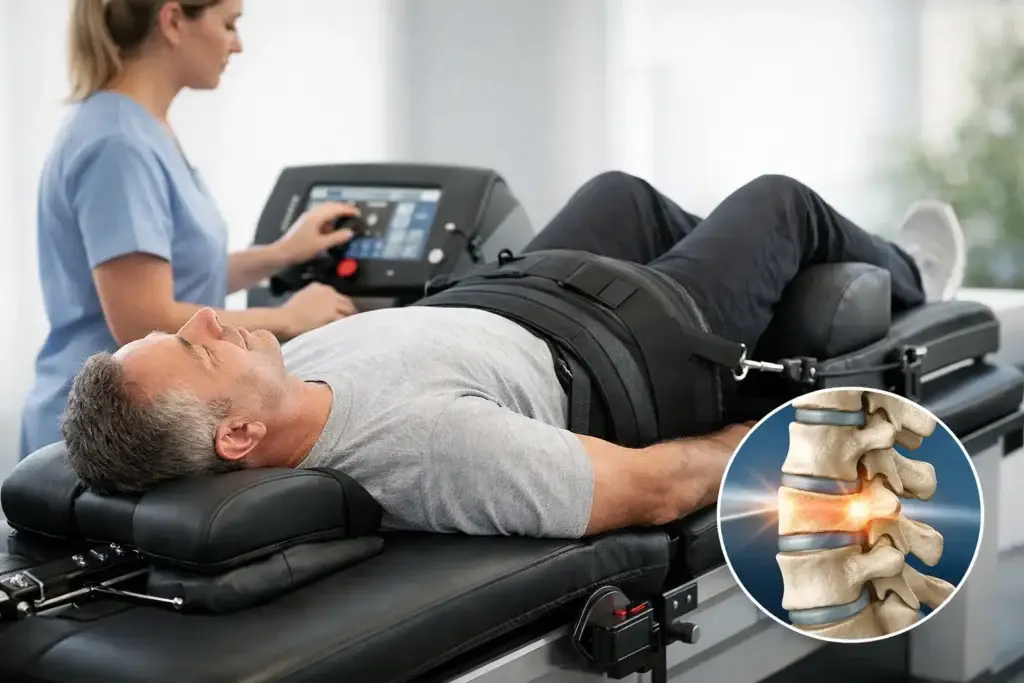
The short answer is that spinal decompression is a controlled, non-surgical treatment designed to reduce pressure within the spine, especially around the discs and nerves. By gently and precisely applying traction, the treatment helps create a negative pressure effect inside the disc. That can encourage bulging or herniated disc material to move away from irritated nerves, improve circulation to damaged tissues, and support the body’s healing process.
That is the simple version. The more useful answer is understanding what is happening mechanically, why precision matters, and who tends to benefit most.
How does spinal decompression work in the spine?
Your spinal discs act like cushions between the vertebrae. They absorb shock, allow movement, and help maintain spacing so nerves can exit the spine without being compressed. When a disc degenerates, bulges, or herniates, that spacing can change. Pressure builds. Inflammation increases. Nerve roots may become irritated. This is often when people feel lower back pain, radiating leg pain, numbness, tingling, or weakness.
Spinal decompression works by applying a carefully calculated stretching force to the spine. This is not the same as a random pull or a basic inversion table. Clinical spinal decompression uses advanced equipment and treatment protocols to target a specific spinal region, whether that is the lumbar spine for low back pain and sciatica or the cervical spine for neck-related disc issues.
As the spine is gently distracted, pressure inside the affected disc can drop. That change in pressure is one of the central reasons the treatment may help. A lower-pressure environment may reduce mechanical stress on the disc and surrounding nerve structures. It may also support the movement of water, oxygen, and nutrients back into the disc, which matters because discs have a limited direct blood supply and heal slowly.
For patients with disc injuries, the goal is not to force the spine into place. The goal is to create the conditions where pressure is reduced, irritation is calmed, and healing becomes more possible.
Why decompression can help disc and nerve pain
Many painful spinal conditions share one common problem: compression. Sometimes the compression comes from a herniated disc pressing on a nerve. Sometimes it comes from disc thinning, degeneration, or joint dysfunction that narrows the available space. Sometimes inflammation is the main driver, but the inflammation is still being fed by poor mechanics and ongoing pressure.
When decompression is done correctly, it may help in several ways at once. It can reduce stress on the disc, lessen nerve root irritation, improve spinal motion, and make other therapies more effective by calming the area first. That combination is one reason decompression is often considered for people who have already tried medication, rest, exercise, or standard chiropractic care without enough progress.
This is especially relevant in cases involving sciatica. If the sciatic-type pain is being driven by a lumbar disc issue, reducing pressure in that region may decrease the irritation feeding the leg symptoms. The same principle can apply in some cases of arm pain, numbness, or tingling related to cervical disc problems.
That said, results depend on the diagnosis. Not every case of back pain is a disc problem, and not every disc problem responds the same way.
What a treatment session usually feels like
One of the biggest concerns patients have is whether spinal decompression hurts. In a properly supervised setting, most people describe it as gentle, controlled, and more comfortable than they expected.
During treatment, you are positioned on a specialized decompression table and secured so the treatment can focus on the intended spinal level. The system is programmed based on your condition, body type, symptoms, and treatment goals. Rather than using a constant pull, advanced decompression systems typically alternate the force in a precise pattern. That matters because the body tends to guard against a sudden or sustained pull. Precision helps the treatment work with the body rather than against it.
A session usually lasts long enough to produce a therapeutic effect without overstressing the tissues. Some patients feel relief early, while others notice gradual improvement over a series of visits. With chronic disc problems, expecting a one-visit fix is rarely realistic. The tissue has often been under stress for months or years, and durable improvement typically requires a treatment plan rather than a single session.
How does spinal decompression work compared with general traction?
This is where confusion often happens. People hear the word traction and assume all spinal stretching is the same. It is not.
General traction can be broad and less targeted. Clinical spinal decompression is designed to be more specific, more controlled, and more responsive to the patient’s spinal condition. Higher-end systems can adjust angle, force, timing, and treatment pattern in ways that are intended to reduce guarding and focus on the affected disc level.
That precision is not a minor detail. In complex cases, especially where there is a disc herniation, recurring sciatica, or failed response to previous treatment, the quality of the evaluation and the technology being used can make a meaningful difference.
At DeSalvo Chiropractic and Decompression, this matters because patients often arrive after trying more generalized approaches that did not address the actual driver of their pain. A decompression plan should not be based on symptoms alone. It should be based on a clear clinical picture of what structure is involved and why.
Who is a good candidate for spinal decompression?
Spinal decompression is often considered for patients with herniated discs, bulging discs, degenerative disc changes, sciatica, certain types of chronic neck or low back pain, and some cases of radiating arm or leg pain tied to nerve compression. It can be a strong option for people who want to avoid more invasive procedures or who are trying to delay or prevent surgery when surgery is not immediately necessary.
It may also be useful for patients who have plateaued with standard care. If pain keeps returning because the disc and nerve mechanics were never adequately addressed, decompression may help create a better foundation for healing.
Still, it is not right for everyone. Severe spinal instability, fractures, certain surgical histories, advanced osteoporosis, some implanted devices, infections, and other medical factors may make decompression inappropriate or require medical clearance first. This is why a detailed exam and review of imaging, when indicated, are so important.
A credible provider should tell you when decompression is not the best fit. In spine care, selecting the right patient is just as important as selecting the right treatment.
Why decompression is often part of a larger treatment plan
Even when spinal decompression is the right tool, it is rarely the only one. Disc injuries and nerve irritation often involve more than pressure alone. There may be muscle guarding, joint restriction, inflammation, altered movement patterns, or weakness that developed as the body tried to protect the painful area.
That is why comprehensive care matters. Decompression may reduce disc and nerve stress, but long-term recovery often improves when treatment also addresses biomechanics, stability, tissue healing, and function. Depending on the case, that could include chiropractic care, laser therapy, electrotherapy, corrective exercises, or other non-surgical strategies designed around the patient’s diagnosis.
This is one of the biggest differences between a symptom-based approach and a root-cause approach. If a patient feels better but the underlying mechanics remain unstable, flare-ups often return. If the pressure is reduced and the spine is supported more effectively, the improvement has a better chance of lasting.
What kind of results should patients expect?
The honest answer is that it depends on the condition, the severity, how long the problem has been present, and whether the diagnosis is accurate. Patients with a true disc-related pain pattern often respond better than patients whose pain is coming from a completely different source.
Some people notice less radiating pain, easier movement, or less pain with sitting after several visits. Others improve more gradually as inflammation calms and irritated tissues begin to recover. Chronic cases usually take more time than recent injuries. Patients with severe weakness, progressive neurological loss, or red-flag symptoms may need a different level of intervention.
The goal of spinal decompression is not just to mask pain for a few hours. The goal is to reduce the mechanical stress driving that pain so the body has a better opportunity to heal.
If you have been dealing with disc pain, sciatica, or recurring back symptoms that keep limiting your work, sleep, or mobility, the best next step is not guessing. It is getting a precise evaluation to determine what is actually causing the pressure and whether spinal decompression is the right solution for your case.
Contact: Dr. Douglas DeSalvo, DC, QME DeSalvo Chiropractic, A Spine & Injury Center (415)898-6888