
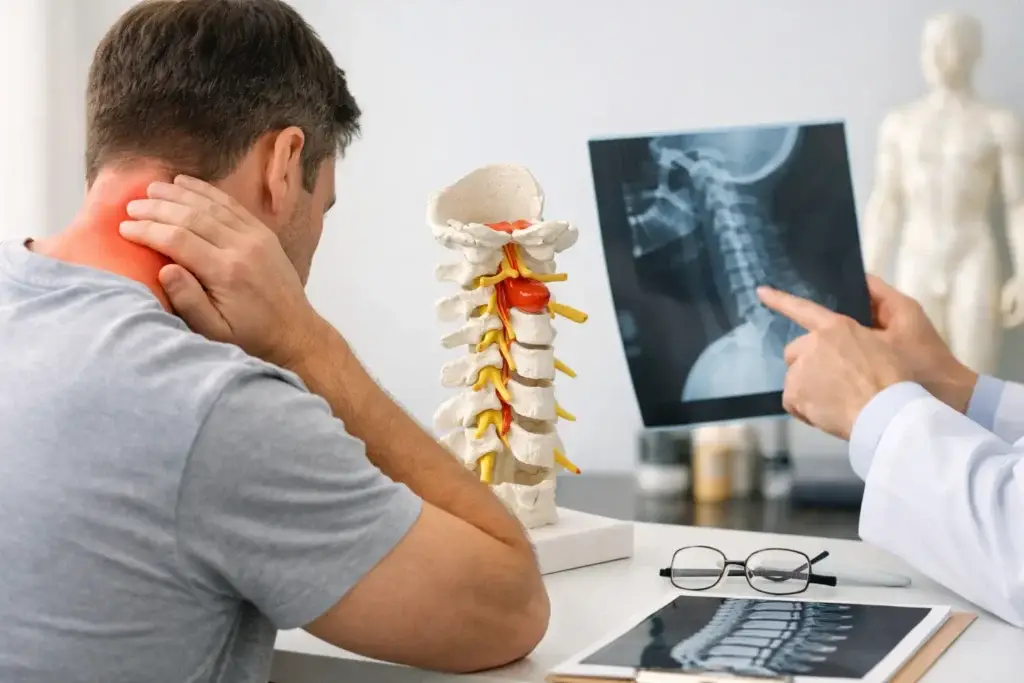
A pinched nerve can make ordinary movements unexpectedly difficult. Turning your head to check traffic, sitting through a meeting, standing at the kitchen counter, or walking across a parking lot may trigger pain, tingling, numbness, or weakness. Effective pinched nerve treatment options are not limited to quieting those symptoms. They begin by identifying where the nerve is being irritated, why that irritation is occurring, and which tissues need to heal or move differently.
The phrase “pinched nerve” is commonly used, but it is not a complete diagnosis. A nerve may be compressed by a bulging or herniated disc, narrowed spaces in the spine, joint degeneration, muscle tightness, inflammation after an injury, or scar tissue. In the neck, irritation can travel into the shoulder, arm, or hand. In the low back, it may produce sciatic pain, numbness, or weakness down the leg. The right treatment depends on that pattern.
Why an Accurate Assessment Comes First
Two people can describe the same burning pain down the leg and have very different underlying problems. One may have a disc herniation placing pressure on a lumbar nerve root. Another may have spinal stenosis, hip dysfunction, peripheral neuropathy, or a muscular condition that mimics sciatica. Treating all of these conditions the same way can delay meaningful improvement.
A thorough evaluation should consider the onset of symptoms, whether a car accident or lifting injury was involved, the direction and distribution of pain, changes in sensation, muscle strength, reflexes, posture, walking mechanics, and range of motion. Depending on the presentation, imaging or coordination with a medical specialist may also be appropriate.
This diagnostic step matters especially when symptoms have persisted despite rest, medication, or general exercise. The goal is to distinguish a temporary flare-up from a problem involving disc injury, progressive nerve compression, or nerve dysfunction that needs more focused care.
Symptoms That Need Prompt Medical Attention
Most pinched nerve symptoms can be evaluated conservatively, but some signs should not be ignored. New or worsening muscle weakness, loss of bowel or bladder control, numbness in the groin or saddle area, severe balance changes, fever with spinal pain, or symptoms after significant trauma warrant urgent medical evaluation. These can indicate conditions that require immediate medical or surgical attention.
Pinched Nerve Treatment Options: A Layered Approach
The best non-surgical plans often combine several therapies rather than relying on a single intervention. The sequence, intensity, and duration should be based on the diagnosis, symptom severity, medical history, and how the body responds over time.
Activity Modification and Strategic Movement
Short-term changes in activity can reduce irritation while the underlying condition is being addressed. This does not necessarily mean complete bed rest. Prolonged inactivity can lead to stiffness, loss of conditioning, and more sensitivity to movement.
Instead, patients may need to temporarily avoid repeated bending, heavy lifting, prolonged sitting, overhead work, or positions that reproduce radiating pain. Carefully selected movement can help preserve mobility and circulation without repeatedly aggravating the nerve. The key is specificity: an exercise that helps one disc-related problem can worsen another if it is performed at the wrong stage or with poor mechanics.
Chiropractic Care for Mechanical Contributors
When spinal joint restriction, altered biomechanics, muscular guarding, or postural strain contribute to nerve irritation, chiropractic care may be part of a conservative treatment plan. Treatment should be tailored to the patient rather than delivered as a one-size-fits-all adjustment routine.
Gentle spinal mobilization, chiropractic adjustments when clinically appropriate, soft-tissue work, and brain-based chiropractic methods may help improve joint motion and reduce mechanical stress around irritated structures. For a patient with acute inflammation or a highly sensitive disc injury, care may need to begin with lower-force techniques before progressing to more active treatment.
The objective is not simply to create temporary motion. It is to improve the conditions that allow the nerve and surrounding tissues to function with less provocation.
Non-Surgical Spinal Decompression
For certain disc-related conditions, non-surgical spinal decompression may be considered. This approach uses controlled traction to gently change pressure within the spine, with the intent of reducing stress on affected discs and nerve roots while supporting fluid exchange in disc tissue.
Decompression is not appropriate for every person with back or neck pain. Its value depends on the diagnosis, the level and severity of disc involvement, bone health, prior surgical history, and other clinical factors. When it is indicated, it is typically delivered as part of a structured program that also addresses mobility, stabilization, and return to normal activity.
At DeSalvo Chiropractic, the Accu-SPINA system is used within individualized non-surgical care plans for appropriate disc and nerve-related cases. This level of planning is particularly relevant for patients who have tried basic conservative care without lasting relief.
Laser Therapy and Electrotherapy
Nerve irritation is often accompanied by inflammation, muscle guarding, and tissue sensitivity. Advanced modalities can support recovery by addressing these components without adding medication burden or invasive procedures.
Class IV laser therapy and cold laser therapy may be used to support cellular repair processes and help reduce pain in selected musculoskeletal and nerve-related conditions. Electrotherapy can be used to influence pain signaling, circulation, and muscle activation, depending on the device and treatment objective. These therapies are generally most useful as part of a broader treatment plan, not as a substitute for correcting the mechanical or functional issue driving symptoms.
Patients with long-standing pain often appreciate that these options can be adjusted to their tolerance. A sensitized nerve may not respond well to aggressive treatment early on, while a more chronic condition may benefit from progressive rehabilitation after pain is better controlled.
Focused Rehabilitation and Nerve Mobility Work
Lasting improvement usually requires the body to regain control as symptoms settle. Rehabilitation may focus on core and spinal stabilization, hip strength, shoulder-blade mechanics, balance, gait, work ergonomics, or lifting technique. The right priorities depend on whether the nerve problem originated in the cervical spine, lumbar spine, extremity, or from trauma.
Nerve mobility exercises can also be useful in specific cases. These are not simply stretches. When prescribed correctly, they may help a nerve move more comfortably through surrounding tissues. When overdone, however, they can increase burning, tingling, or radiating pain. This is one reason self-directed online exercise programs are not always the right answer for persistent symptoms.
Where Medication, Injections, and Surgery Fit
Medication may be appropriate for short-term symptom management, particularly when pain is interfering with sleep, work, or basic mobility. Anti-inflammatory medication, pain relievers, or other prescriptions may reduce symptoms enough for a patient to participate in rehabilitation. The trade-off is that medication can manage pain without resolving the source of mechanical compression or dysfunction, and some options carry side effects or are not suitable for every medical history.
Epidural steroid injections may be considered when inflammation around a nerve root is substantial and conservative treatment has not provided adequate relief. Some patients experience meaningful temporary improvement, while others have limited benefit. An injection can be valuable when it helps restore function or creates an opportunity to progress with rehabilitation, but it should be considered in the context of a complete treatment strategy.
Surgery may be necessary when there is significant or progressive neurological loss, severe structural compression, spinal instability, or persistent disabling symptoms that do not respond to appropriate conservative care. Surgery can be highly valuable in the right circumstance. It is not a failure of conservative treatment, nor is it automatically the first step for every disc or nerve complaint. Careful diagnosis helps patients make that decision with clearer expectations.
Recovery Depends on More Than Pain Level
Pain relief is a meaningful milestone, but it is not the only marker of recovery. A patient may feel better at rest yet still have weakness, poor movement control, limited endurance, or a tendency to trigger symptoms during work and recreation. Returning too quickly to the same aggravating patterns can create repeated flare-ups.
A well-designed plan tracks practical changes: Can you sit longer without leg pain? Can you turn your head without arm tingling? Is your grip strength improving? Are you walking farther, sleeping better, or relying less on medication? These functional measures help determine whether treatment is addressing the problem rather than merely masking it.
Persistent nerve symptoms deserve more than generic advice to rest or stretch. A precise evaluation and an individualized non-surgical plan can clarify what is driving the irritation, what should be protected, and what needs to be strengthened so everyday movement becomes more comfortable and dependable again.