
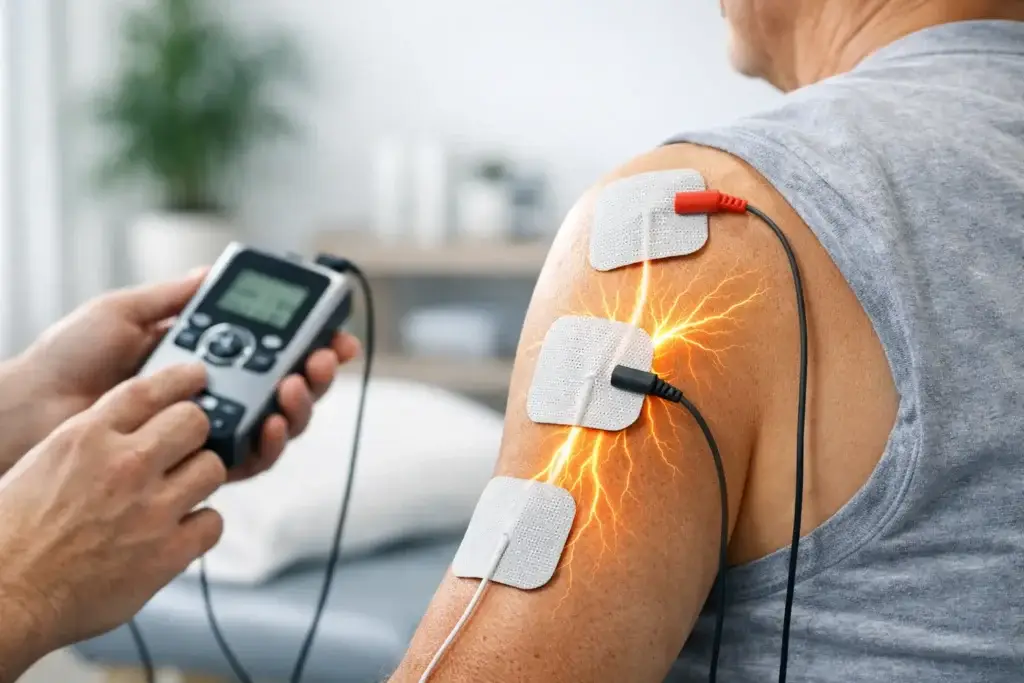
Nerve pain has a way of disrupting far more than comfort. Burning, tingling, electric-shock sensations, numbness, weakness, or pain that travels from the back into the leg can make sleep, work, driving, and exercise feel unpredictable. Electrotherapy for nerve pain is a non-invasive treatment approach that uses precisely controlled electrical stimulation to help reduce pain signals, improve circulation, and support the nervous system’s recovery process.
For the right patient, it can be a valuable part of care. It is not a one-size-fits-all solution, and it should not be used as a substitute for finding out why a nerve is irritated in the first place. The most effective treatment plans pair symptom relief with a careful evaluation of spinal mechanics, disc health, injury history, circulation, muscle function, and neurological findings.
What Electrotherapy Does for Nerve Pain
Electrotherapy uses electrical currents delivered through surface electrodes placed on the skin. The treatment is adjusted according to the area being treated, the patient’s sensitivity, and the clinical goal. Some settings are designed to influence how pain signals travel to the brain, while others may encourage muscle activation, circulation, or tissue recovery.
When a nerve is irritated or compressed, the nervous system can become highly reactive. A light touch, a certain position, or even normal movement may trigger disproportionate pain. Electrical stimulation may help modulate that sensitivity by providing competing sensory input to the nervous system. In simple terms, it can help turn down the volume on pain signals while the underlying condition is addressed.
For some patients, treatment also promotes local blood flow and helps reduce protective muscle guarding. This matters when tight muscles around the low back, hip, neck, or shoulder are contributing to nerve irritation. Better circulation does not cure a damaged nerve by itself, but it can create a more favorable environment for healing and movement.
The experience should be comfortable. Most patients feel a tingling, pulsing, tapping, or gentle muscle contraction, depending on the setting used. Strong pain, burning, or worsening symptoms are not expected and should be reported immediately.
Conditions That May Respond to Electrotherapy for Nerve Pain
Nerve-related symptoms can arise from several sources. Sciatica is one of the most common examples, often causing pain, tingling, or numbness that extends from the low back or buttock down one leg. A disc bulge or herniation, spinal stenosis, degenerative changes, or injury-related inflammation may place pressure on a nerve root and create these symptoms.
Electrotherapy may also be considered for peripheral neuropathy, neck pain with radiating arm symptoms, post-injury nerve irritation, and certain chronic pain presentations. It is sometimes used alongside care for fibromyalgia when widespread pain and nervous system sensitivity limit activity and sleep.
The diagnosis matters. Tingling in the feet may be related to peripheral neuropathy, but it can also reflect a lumbar nerve problem, circulation changes, medication effects, metabolic conditions, or another medical issue. Likewise, pain that shoots down the arm may originate in the neck, shoulder, wrist, or peripheral nerve pathway. Treating symptoms without identifying the source can delay meaningful improvement.
Why the Cause of Nerve Pain Changes the Plan
A nerve is not always injured simply because it hurts. It may be compressed, inflamed, overstretched after trauma, deprived of adequate blood flow, or sensitized by ongoing pain. Each scenario calls for a different clinical strategy.
For example, a patient with sciatica related to a disc injury may benefit from electrotherapy as part of a program that also includes non-surgical spinal decompression, targeted chiropractic care, and progressive rehabilitation. The goal is not only to make the leg pain more tolerable. It is to reduce mechanical stress on the involved nerve and restore the ability to move with confidence.
A patient with peripheral neuropathy may need a different approach focused on circulation, sensory changes, balance, gait, and lower-extremity function. Someone recovering from a motor vehicle collision may have pain from a combination of soft-tissue injury, joint dysfunction, muscle guarding, and nerve sensitivity. In these cases, an individualized plan is far more useful than applying the same electrical setting to every painful area.
At DeSalvo Chiropractic, evaluation is designed to determine whether symptoms appear to be spine-related, peripheral nerve-related, injury-related, or influenced by more than one factor. That distinction helps guide treatment selection and identifies when co-management or referral is appropriate.
Types of Electrical Stimulation Used in Clinical Care
The term electrotherapy covers more than one treatment method. The best choice depends on the patient, diagnosis, and treatment objective.
TENS for pain modulation
Transcutaneous electrical nerve stimulation, commonly called TENS, primarily targets pain perception. Low-level electrical stimulation is delivered through the skin to help interfere with pain messages traveling toward the brain. TENS may be useful for temporary symptom management, particularly when pain is limiting sleep or normal activity.
Its limitation is equally important: relief can be temporary if the source of nerve irritation remains unchanged. TENS can be helpful, but it is usually most valuable as one component of a larger care plan.
Interferential and medium-frequency stimulation
Interferential current and other medium-frequency therapies are often used for deeper, broader treatment areas such as the low back, hip, or shoulder region. Many patients find these currents comfortable because the higher frequency can be less irritating at the skin surface. Depending on the protocol, treatment may be used to address pain, muscle guarding, swelling, or circulation concerns.
Neuromuscular electrical stimulation
Neuromuscular electrical stimulation is intended to create controlled muscle contractions. It may be used when pain, injury, or nerve dysfunction has contributed to muscle inhibition or weakness. The purpose is not to force an injured area through activity. Rather, it may help reintroduce appropriate muscle engagement when clinically indicated.
Advanced electrotherapy protocols
Specialized systems, including HAKO-MED electrotherapy, allow clinicians to tailor current type, intensity, timing, and treatment sequences more precisely than a basic home device. Advanced equipment does not replace clinical judgment. Its value is in how it is applied within a diagnosis-driven treatment plan and adjusted as symptoms and function change.
What Treatment Usually Looks Like
A proper visit begins with more than placing pads on a painful area. A clinician should ask where symptoms begin, where they travel, what makes them worse, whether numbness or weakness is present, and how the condition affects daily function. Examination may include range-of-motion testing, orthopedic and neurological assessments, posture and movement evaluation, and review of prior imaging or medical records when available.
During electrotherapy, electrodes are positioned based on the suspected pain pathway and treatment goal. A session often lasts 15 to 30 minutes, although the larger treatment appointment may include other therapies. Settings should be adjusted to the patient’s comfort and response, not simply set to the highest tolerable intensity.
Some patients notice relief after the first few sessions. Others improve gradually as pain sensitivity decreases and movement becomes easier. Chronic nerve pain, long-standing disc problems, and neuropathy often require a more structured course of care. Progress should be measured by meaningful changes: less radiating pain, improved sleep, longer walking tolerance, better balance, reduced medication reliance when medically appropriate, or a return to activities that pain had limited.
When Electrotherapy Is Not Appropriate
Electrical stimulation is generally well tolerated, but it is not suitable for everyone or every body area. Patients with implanted electrical devices such as pacemakers or certain defibrillators need medical clearance before treatment. Electrodes should not be placed over areas of impaired skin integrity, active infection, known cancer without medical guidance, or the front of the neck.
Pregnancy, significant loss of sensation, seizure disorders, vascular concerns, and complex medical histories require careful screening and treatment modifications. A clinician should also investigate promptly if a patient has progressive weakness, loss of bowel or bladder control, saddle numbness, unexplained weight loss, fever, or severe pain following major trauma. Those symptoms may require urgent medical evaluation rather than conservative care alone.
A More Complete Path Toward Relief
Electrotherapy can be useful because it gives an irritated nervous system a chance to settle while the body is guided toward healthier movement and function. Yet lasting results usually depend on more than reducing pain for an hour or a day. The mechanical, inflammatory, neurological, and lifestyle factors driving symptoms need attention as well.
If nerve pain is keeping you from sleeping comfortably, walking normally, working without distraction, or trusting your body after an injury, the next productive step is a detailed evaluation. The right treatment is the one that matches the source of your symptoms, protects your safety, and gives you a realistic path back to daily life.