
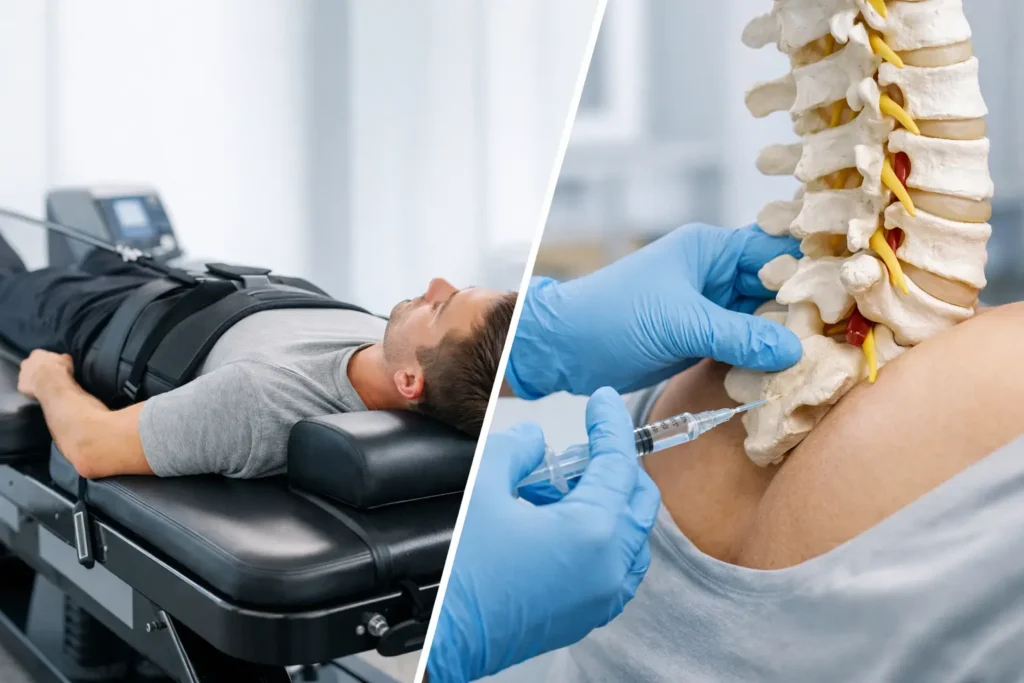
A sharp pain traveling from the low back into the buttock, calf, or foot can make even a short drive or a full night of sleep difficult. For patients facing disc-related pain or sciatica, the question of decompression versus epidural injection therapy is not simply about choosing a procedure. It is about understanding what is compressing or irritating the nerve, what each option is designed to do, and which path best supports lasting function.
Decompression Versus Epidural Injection Therapy: The Core Difference
Non-surgical spinal decompression and epidural steroid injections can both be considered for back pain with radiating leg symptoms, but they approach the problem differently.
Spinal decompression is a non-invasive mechanical treatment. A computerized traction system applies carefully controlled pulling and relaxation forces to the spine. The goal is to reduce pressure within a damaged or bulging disc, improve the disc’s ability to exchange fluids and nutrients, and create conditions that may reduce mechanical stress on nearby nerve structures.
An epidural injection is a medical procedure in which anti-inflammatory medication, typically a corticosteroid with a local anesthetic, is delivered into the epidural space around the spinal nerves. Its primary purpose is to reduce inflammation and calm pain arising from irritated nerve tissue.
In straightforward terms, decompression aims to address mechanical loading around the disc and spinal structures. An epidural injection aims to decrease inflammation around the irritated nerve. Both may have a role in care, but neither is automatically the best first answer for every painful back or sciatic condition.
When an Epidural Injection May Be Considered
Epidural steroid injections are often considered when nerve pain is intense, persistent, and limiting daily activity despite initial conservative care. They may be used for symptoms associated with a disc herniation, spinal stenosis, degenerative disc changes, or inflammation affecting a nerve root.
For some patients, an injection can provide a useful reduction in pain that makes it easier to sleep, walk, participate in rehabilitation, or avoid immediate surgery. In diagnostic situations, the response to a targeted injection may also offer information about which nerve level is contributing to symptoms.
The limitation is that an epidural injection does not repair a damaged disc, reverse spinal narrowing, or correct the movement and loading patterns that may continue to aggravate the area. Relief can be substantial for some people, modest for others, or temporary. Response varies based on the diagnosis, severity of nerve involvement, duration of symptoms, injection approach, and individual health factors.
Injections also involve considerations that deserve a medical discussion. Potential risks include temporary soreness, headache, bleeding, infection, elevated blood sugar, and steroid-related effects. Although serious complications are uncommon, they are possible. Repeated steroid exposure may not be appropriate for every patient, especially those with certain metabolic conditions, infection risk, bleeding concerns, or a history of adverse responses to steroids.
How Non-Surgical Spinal Decompression Works
Non-surgical decompression is commonly used in carefully selected patients with disc bulges, disc herniations, degenerative disc disease, chronic low back pain, neck pain, and radiating symptoms such as sciatica. Treatment is delivered over a series of sessions rather than through a single intervention.
During treatment, the patient is positioned comfortably on a decompression table while the system delivers computer-controlled cycles of distraction and relaxation. This controlled approach differs from generic traction because the treatment pattern is designed to minimize protective muscle guarding while applying precise force to the targeted region.
At DeSalvo Chiropractic, the Accu-SPINA spinal decompression system may be incorporated into a customized treatment plan when clinical findings support its use. The plan may also include chiropractic care, laser therapy, electrotherapy, targeted rehabilitation, and movement guidance. The objective is not merely to reduce pain during a visit. It is to improve the conditions that allow the spine and nervous system to function with less irritation over time.
Decompression is not a substitute for every form of spinal care. It may not be appropriate for patients with spinal fracture, severe osteoporosis, spinal instability, certain surgical implants, active cancer affecting the spine, infection, or progressive neurologic deficits. A careful examination and review of imaging, when available, are essential before recommending treatment.
Which Option Better Fits Disc Pain and Sciatica?
The right choice depends on the source of symptoms. Sciatica is a symptom pattern, not a diagnosis. Burning, numbness, tingling, weakness, or pain down the leg can result from a disc herniation, narrowing around the nerve, joint dysfunction, trauma, peripheral nerve conditions, or more than one issue at the same time.
A patient with a recent disc flare and severe inflammatory leg pain may be a reasonable candidate for an epidural injection, particularly when the immediate goal is to calm pain enough to restore basic function or begin rehabilitation. An injection may also be considered when conservative care has not provided adequate relief and the clinical picture supports nerve-root inflammation.
A patient with chronic disc-related pain, recurring sciatica, mechanical sensitivity to sitting or bending, and no red-flag findings may be better suited to a structured non-surgical decompression program. This is particularly relevant when the treatment goal includes reducing ongoing disc stress while rebuilding strength, mobility, and tolerance for normal activity.
Sometimes the answer is not either-or. An injection may provide short-term symptom control while a patient works through a rehabilitation plan. In other cases, a patient may prefer to pursue non-invasive care first before considering an injection. The sequence should be based on clinical findings, symptom severity, medical history, imaging, and the patient’s goals.
The Importance of a Complete Evaluation
Choosing treatment based only on an MRI report or the location of pain can lead to missed details. Many adults have disc bulges or degenerative changes on imaging without symptoms. Conversely, a relatively small disc issue can be highly symptomatic if it affects a sensitive nerve root.
A meaningful evaluation should connect the patient’s history, orthopedic examination, neurologic findings, movement tolerance, prior treatment response, and imaging when indicated. Changes in reflexes, sensation, muscle strength, gait, and functional capacity can help determine whether a nerve is irritated, compressed, or showing signs that warrant medical or surgical consultation.
Urgent evaluation is needed for new or worsening leg weakness, loss of bowel or bladder control, saddle-area numbness, fever with severe spinal pain, unexplained weight loss, or significant symptoms after major trauma. These findings are not appropriate for routine decompression or a wait-and-see approach.
What Results Should You Expect?
The most realistic goal is not simply a lower pain score. Effective care should help you tolerate sitting, standing, walking, working, sleeping, and exercising with greater confidence. For patients with disc and nerve conditions, progress is often measured through changes in pain distribution, reduced numbness or tingling, improved range of motion, better strength, and fewer activity limitations.
Epidural injections can sometimes reduce pain quickly, but the duration of benefit is variable. Decompression typically requires consistency over several weeks, and results are influenced by the condition being treated, the chronicity of symptoms, daily habits, rehabilitation participation, and whether the diagnosis is accurate.
Neither treatment should be presented as a guarantee. A credible treatment plan includes clear expectations, reassessment points, and a willingness to adjust the approach if progress does not match the clinical goals.
A Better Question Than “Which Treatment Is Best?”
Rather than asking whether decompression or an epidural injection is universally better, ask what is driving your symptoms and what outcome you need most right now. If inflammation is dominating an acute nerve flare, an injection may have value. If ongoing disc loading and mechanical dysfunction are central to the problem, a non-surgical decompression program may offer a more appropriate path.
The best next step is a thorough assessment that identifies the source of pain, screens for conditions requiring medical referral, and builds a plan around both relief and recovery. When the treatment matches the diagnosis, patients have a clearer path back to movement, work, and the activities pain has been interrupting.