
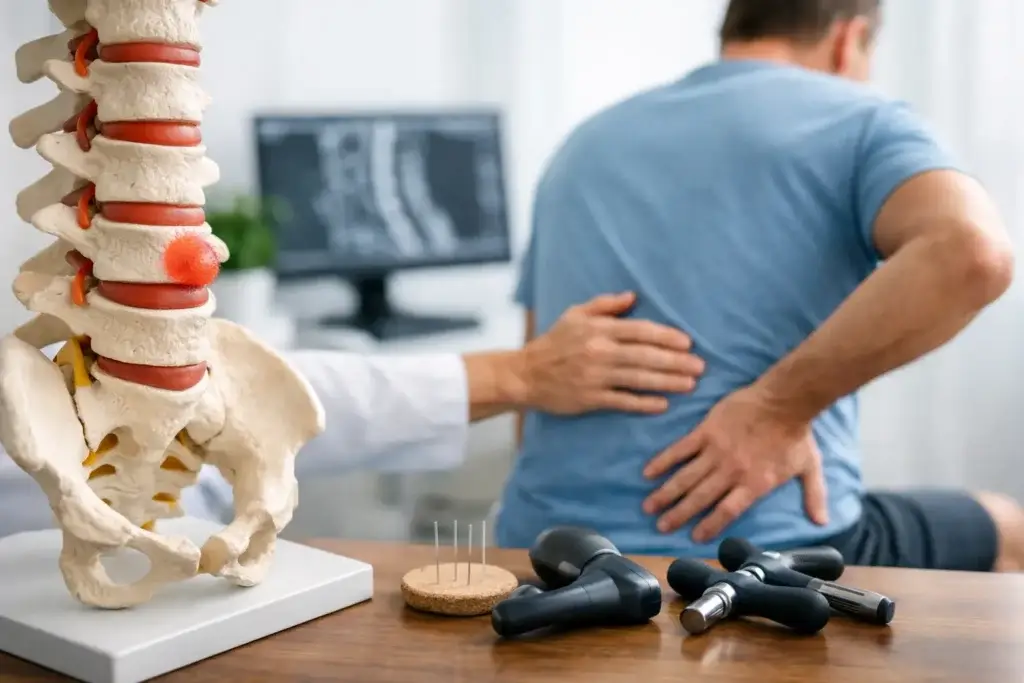
A disc problem can make ordinary movements feel calculated: getting out of the car, putting on shoes, sitting through a meeting, or turning over in bed. For many people, the pain is not limited to the low back or neck. It may travel into the buttock, leg, arm, hand, or foot as numbness, tingling, burning, or weakness. This guide to non surgical disc care explains what a thoughtful conservative plan should address, when it may help, and when symptoms require more urgent medical attention.
Disc pain is not one diagnosis
Spinal discs are the shock-absorbing cushions between the bones of the spine. Each disc has a tougher outer layer and a softer center. With aging, repetitive strain, a sudden injury, or a combination of factors, a disc can lose height, bulge, tear, or herniate. If disc material or inflammation irritates a nearby nerve, the result may be sciatica, radiating arm pain, altered sensation, or loss of strength.
That does not mean every MRI finding is the source of pain. Disc bulges and degeneration are common, including in people without symptoms. Conversely, a patient may have significant nerve pain with imaging that does not tell the whole clinical story. Effective care begins by matching the patient’s symptoms, physical examination, movement patterns, neurological findings, and imaging when appropriate.
This distinction matters because treating a scan rather than a person often leads to temporary, unfocused care. The goal is to identify the structure and nerve involvement most likely driving the problem, then build a plan around function, pain reduction, and tissue tolerance.
When disc symptoms need immediate attention
Most disc-related pain can be evaluated and treated conservatively, but a few symptoms should never be watched at home. Seek urgent medical evaluation for new bowel or bladder control problems, numbness in the groin or saddle area, rapidly progressing leg or arm weakness, severe loss of coordination, fever with severe spinal pain, or pain after significant trauma.
A sudden foot drop, difficulty standing from a chair because of weakness, or worsening loss of hand function also deserves prompt assessment. These symptoms do not automatically mean surgery is necessary, but they do require timely evaluation to protect nerve function.
The first step: determine the pain generator
A precise consultation should go beyond asking where it hurts. A clinician should assess the location and behavior of symptoms, what positions aggravate or ease them, whether pain travels below the knee or elbow, and whether there is numbness, weakness, or altered reflexes. A history of car accident injury, prior surgery, diabetes, osteoporosis, inflammatory disease, or anticoagulant use can also change the treatment approach.
The examination may include range-of-motion testing, orthopedic testing, sensory and strength assessments, gait evaluation, and analysis of how the spine and nervous system respond to movement. Imaging may be useful when symptoms are severe, persistent, traumatic in origin, associated with neurological deficits, or not responding as expected. X-rays can show alignment and degenerative changes, while MRI is generally more informative for discs, nerves, and soft tissues.
The right diagnosis is not about assigning a dramatic label. It is about answering practical questions: Is a nerve under stress? Is the disc likely involved? Is there a mechanical restriction, muscular guarding, or instability contributing to the problem? Is conservative care appropriate and safe?
A guide to non-surgical disc care: the core components
Non-surgical disc care is not a single treatment. The best programs use carefully selected therapies and progress them according to the patient’s response. A person with acute sciatica after lifting a heavy box needs a different starting point than someone with years of disc degeneration, recurrent flare-ups, and deconditioning.
Reduce mechanical stress without becoming inactive
In the early phase, the priority is often calming irritated tissues and reducing positions that repeatedly provoke symptoms. That may mean temporarily limiting heavy lifting, prolonged bending, twisting under load, or long periods of unsupported sitting. It does not usually mean strict bed rest. Too much inactivity can increase stiffness, weaken supportive muscles, and make return to normal activity more difficult.
Patients often benefit from learning how to move strategically: using a hip hinge rather than rounding the low back, breaking up long drives or desk time, and modifying sleep or work positions. Small changes can reduce repeated strain while the spine is recovering.
Consider non-surgical spinal decompression when appropriate
For certain disc-related conditions, non-surgical spinal decompression may be used to gently and repeatedly change the forces through the spinal segments. The intention is to reduce pressure on affected structures, improve disc nutrition through fluid exchange, and create a more favorable environment for recovery.
Technology matters, but patient selection matters more. Advanced systems such as Accu-SPINA can deliver controlled protocols tailored to the individual, rather than relying on generalized traction. Decompression is not appropriate for every patient, and it should be prescribed after a proper examination. Conditions such as fracture, certain forms of instability, severe osteoporosis, infection, or other medical concerns may require a different approach.
Address inflammation, pain signaling, and tissue recovery
Persistent disc pain is rarely just a structural issue. Nerves can become sensitized, muscles can guard, and altered movement patterns can maintain symptoms long after the initial injury. Depending on the presentation, a provider may incorporate therapies such as MLS Class IV laser therapy, cold laser therapy, or HAKO-MED electrotherapy to support pain control, circulation, and tissue recovery.
These modalities are not substitutes for diagnosis or rehabilitation. Their value is often in helping a patient tolerate movement and progress through care more comfortably. If a treatment provides short-lived relief but does not improve walking, sitting, sleeping, strength, or daily activity, the plan should be reassessed.
Restore control, strength, and confidence in movement
A disc may calm down before the body is ready to resume every previous demand. Structured rehabilitation is where non-surgical care becomes more durable. The focus may include spinal stabilization, hip mobility, core endurance, gait mechanics, balance, and gradual exposure to the activities that previously triggered pain.
Progression should be specific. A warehouse employee may need a lifting and carrying progression. A Bay Area commuter may need strategies for prolonged driving and sitting. An active adult who wants to return to golf, cycling, or gardening needs a plan that builds capacity for those exact movements.
The goal is not to make the spine fragile or to teach patients to fear bending forever. It is to restore appropriate control and load tolerance so normal life becomes less threatening to the nervous system.
What results should you expect?
Recovery timelines vary. Some people improve significantly within weeks, while longstanding pain, recurrent disc injuries, trauma-related cases, or significant nerve involvement may require a longer course. Improvement is not always perfectly linear. A temporary flare after increased activity does not necessarily mean new damage, but worsening neurological symptoms should be reported promptly.
Meaningful progress is broader than a pain score. It can include fewer episodes of radiating pain, reduced numbness, longer walking tolerance, better sleep, less reliance on medication, improved ability to work, and renewed confidence with daily tasks. A quality program measures these changes and adjusts treatment based on objective findings and functional results.
At DeSalvo Chiropractic, complex disc and nerve cases are approached with individualized diagnostics, advanced non-surgical technology, and structured rehabilitation rather than a one-size-fits-all treatment schedule. That level of clinical planning is particularly valuable for patients who have tried generic care without lasting improvement.
When conservative care may not be enough
Non-surgical treatment is often a sensible first step when there are no emergency neurological signs, but it is not a promise that every disc condition will resolve without specialist intervention. Surgery may be considered when there is progressive weakness, significant loss of function, spinal instability, severe symptoms that remain disabling despite appropriate conservative care, or a condition that requires surgical correction.
A responsible non-surgical provider does not delay necessary referral. The purpose of conservative care is to give the body the best opportunity to heal and function while monitoring for signs that the treatment path should change.
Disc pain can narrow a person’s life quickly, especially when every movement seems to carry a consequence. The right care plan replaces guesswork with a clear clinical process: identify the source, protect nerve function, reduce mechanical stress, rebuild movement capacity, and make decisions based on measurable progress.