
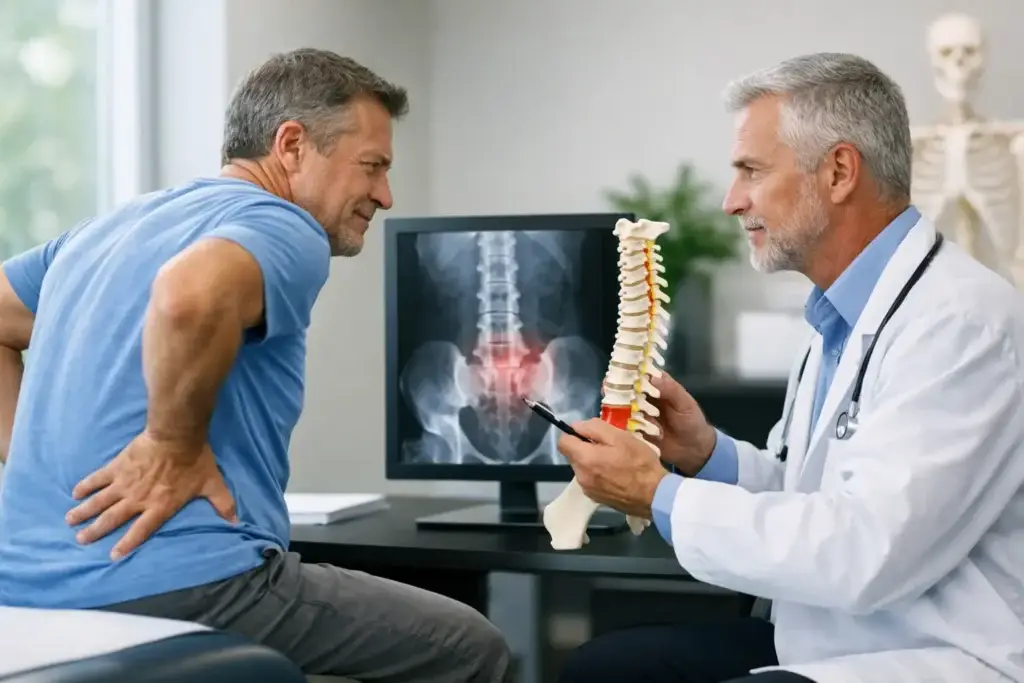
A sharp pain traveling from the low back into the buttock, thigh, calf, or foot can make ordinary tasks feel calculated. Sitting through a meeting, getting in and out of the car, or sleeping through the night may become difficult. Meaningful sciatica relief starts by identifying what is irritating the nerve and why it has not settled down on its own.
Sciatica is not simply “back pain.” It describes symptoms caused by irritation or compression of the sciatic nerve roots, most commonly in the lower spine. The source may be a disc problem, spinal narrowing, joint dysfunction, muscle-related nerve compression, or a combination of factors. That distinction matters because the most effective treatment plan depends on the underlying cause, the severity of nerve involvement, and the patient’s functional limitations.
What Sciatica Symptoms Can Tell You
Sciatica often affects one side of the body, although symptoms can vary widely. Some people experience an electric or burning pain that starts in the lower back and runs down the leg. Others notice numbness, tingling, weakness, or a feeling that the leg may give way. For some, leg pain is far more prominent than back pain.
The pattern of symptoms can offer useful clinical clues. Pain that worsens with sitting, bending, coughing, or sneezing may be associated with disc irritation. Symptoms that increase while standing or walking but ease when leaning forward may point toward spinal stenosis, a narrowing around the nerve pathways. Persistent symptoms following a car accident, fall, or lifting injury deserve especially careful assessment, since trauma can aggravate an underlying disc or joint injury.
Not every pain in the leg is sciatica. Hip conditions, sacroiliac joint dysfunction, peripheral neuropathy, vascular problems, and muscle injuries can produce symptoms that feel similar. A thorough examination is the first safeguard against treating the wrong problem.
Why a Root-Cause Evaluation Matters for Sciatica Relief
When pain is intense, it is understandable to want the fastest possible solution. Rest, anti-inflammatory medication, heat, ice, and gentle movement can be useful short-term measures for some patients. But recurring symptoms or pain that continues beyond the early phase often signals that more than temporary symptom control is needed.
A comprehensive evaluation should consider posture, spinal movement, reflexes, muscle strength, sensation, gait, and the specific activities that provoke symptoms. Depending on the case, diagnostic imaging or coordination with other medical providers may be appropriate. The goal is to determine whether the primary driver is a disc herniation, degenerative change, nerve inflammation, mechanical instability, trauma-related injury, or another condition.
This level of specificity helps avoid a one-size-fits-all approach. For example, an exercise that is helpful for one type of back pain can aggravate symptoms in a person with an active disc-related nerve irritation. Similarly, spinal decompression may be considered when disc involvement is present, but it is not automatically appropriate for every patient with leg pain.
Non-Surgical Options That May Help
A well-designed conservative care plan aims to reduce nerve irritation, improve movement, and restore the ability to tolerate daily activity. The right combination depends on the diagnosis and the patient’s response over time.
Chiropractic Care and Movement Restoration
Targeted chiropractic treatment may help improve restricted spinal and pelvic motion, reduce mechanical stress, and support better movement patterns. In complex cases, care should be based on examination findings rather than a routine protocol. Gentle, precise techniques may be preferable when pain is acute, mobility is significantly limited, or the patient is recovering from trauma.
Treatment should also extend beyond the adjustment itself. Rehabilitation may include carefully selected mobility work, core stabilization, posture correction, and guidance on safe lifting, sitting, and sleeping positions. The objective is not merely to create a brief reduction in pain, but to help the spine and nervous system tolerate normal life more effectively.
Non-Surgical Spinal Decompression
For certain disc-related conditions, non-surgical spinal decompression may be an important part of care. This therapy uses controlled traction to reduce pressure within spinal discs and create a more favorable environment for irritated tissues. It is commonly considered for patients with disc bulges, disc herniations, degenerative disc changes, or radiating leg symptoms when clinical findings support its use.
Results are not identical for every patient. Duration of symptoms, disc condition, neurologic findings, overall health, and adherence to rehabilitation all influence recovery. A credible provider should explain whether decompression fits the clinical picture, what the treatment plan involves, and when another medical option may be more appropriate.
Laser Therapy and Electrotherapy
Advanced therapies can complement hands-on care and rehabilitation when inflammation, muscle guarding, or nerve sensitivity is limiting progress. Class IV laser therapy and cold laser therapy may be used to support tissue healing and help manage pain. Electrotherapy can be used to address pain, muscle dysfunction, or circulation-related concerns, depending on the system and treatment objective.
These technologies are not substitutes for a diagnosis or a complete care plan. Their value is greatest when they are matched to a clear clinical goal and integrated with corrective treatment, progressive activity, and reassessment.
What You Can Do Between Visits
The instinct to stay completely still is common during a sciatica flare, but prolonged bed rest can lead to greater stiffness and deconditioning. For many people, brief and frequent movement is more productive than trying to push through a long walk or a demanding workout. The key is to avoid movements that consistently send pain farther down the leg or create increasing numbness and weakness.
Pay attention to positions that aggravate symptoms. If sitting is difficult, try standing and walking for a few minutes at regular intervals. If symptoms worsen with repeated bending, use hip movement and a neutral spine when reaching for lower objects. When getting out of bed, roll to your side first, then use your arms to push up rather than twisting sharply through the lower back.
Gentle exercises can help, but they should be selected carefully. Stretching aggressively into sharp radiating pain is not a productive strategy. A clinician can determine whether nerve glides, directional movement exercises, hip mobility work, or stabilization exercises are appropriate for your condition.
When Sciatica Needs Urgent Medical Attention
Most cases of sciatica do not require emergency care, but certain symptoms should never be ignored. Seek urgent medical evaluation for new loss of bladder or bowel control, numbness in the groin or saddle area, rapidly progressing leg weakness, severe unrelenting pain after significant trauma, fever with severe back pain, or unexplained weight loss with persistent symptoms.
Progressive weakness deserves particular attention. Difficulty lifting the front of the foot, repeated tripping, or a noticeable loss of leg strength may indicate significant nerve involvement. Early assessment can help clarify the next step and reduce the risk of prolonged dysfunction.
A More Precise Path Forward
Sciatica can be disruptive, but persistent symptoms do not automatically mean surgery is inevitable. Many patients improve with well-directed, non-surgical care that addresses disc stress, joint mechanics, nerve irritation, and the movement patterns that keep the condition active. The best approach is neither to dismiss leg pain as routine nor to assume every case requires the same treatment.
At DeSalvo Chiropractic, patients from Marin, Sonoma, Napa, and the greater Bay Area can receive a detailed evaluation and individualized plan built around the findings of their case. When care is guided by an accurate diagnosis, measurable progress, and appropriate technology, sciatica relief becomes a practical goal rather than a cycle of short-lived fixes.
If leg pain, tingling, or weakness is limiting your work, sleep, or mobility, the next helpful step is a focused evaluation that explains what is happening and what options are most appropriate for your spine and nervous system.